Monday, April 4, 2011

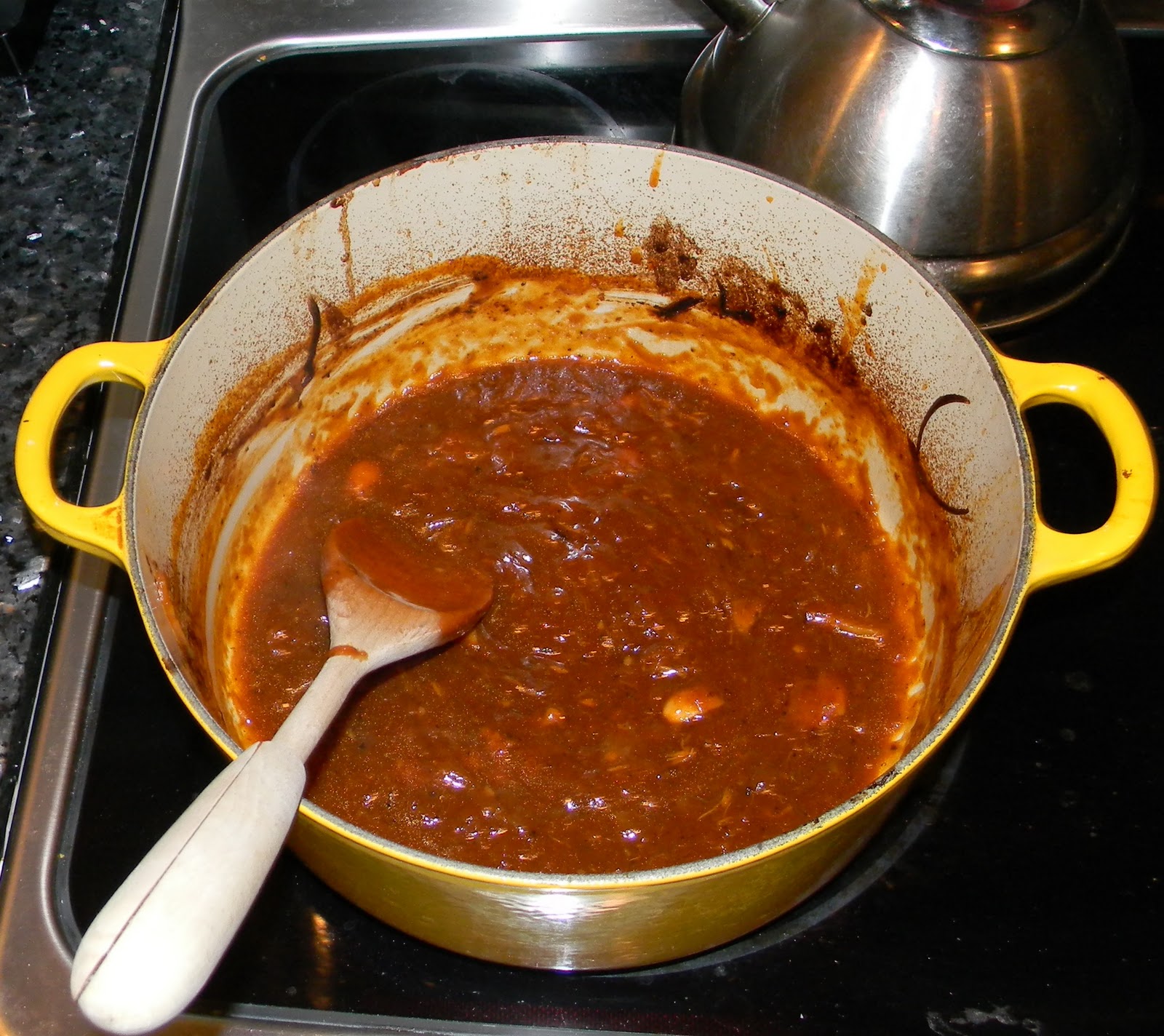
Moroccan Beef Tagine

Every time I think of tagines, I think of Felicia Ruiz www.modernfrida.blogspot.com and working for her at her former restaurant Lola tapas bar.  Her  long, dark, wavy hair would be pulled up with an exotic scarf. Her lips tinted with red Chanel lipstick and her vintage dress would be guarded from spills and splatters by one of her many colorful aprons.
I looked up to her as my mentor and my teacher of all worldly things.
She always had stories to tell me of her trips to Spain, Italy, and Morocco.  While she would prepare the nightly special, I would be marinating and jarring the weeks batch of spiced olives.  I was never able to work efficiently with her. I say this because when she has a story to tell you, you'll want to stop what you're doing so you can go along on the journey.
Her trip to Morocco got me lost in winding alley ways, colorful scarves, and henna stained hands. Spices, herbal remedies, and clay tagines simmering away.  Street vendors offering grilled meats. Women cooking over wood-fired stoves-getting dinner ready for their families. Shops selling specialty lemon preserves and the use of harissa everywhere...(I learned about preserved lemons and making harissa from Felicia.)
I can only imagine the aromas she was describing. --At this point my stomach was growling.  It didn't help that there was bread baking in the oven, tortilla de patatas cooling on the rack, and Felicia carefully opening pomegranates to add to the night's special.  She'd go on to tell me about tagines and Moroccan cuisine and tips she'd pick up from her travels.
A tagine is not only the name of the dish, but it is the vessel Moroccan's (and other North African countries) use to slow cook stews in. The cone on top helps keep moisture in by capturing the condensation and allowing it to drip back down to the base.  A helpful tip Felicia gave me, one she learned from a Moroccan housewife, is to dampen paper towels and wrap it around the bottom of the cone to give it a good seal.
Although I've never tried any of Felicia's tagine recipes, the recipe I'm sharing with you is a great one to start with. I didn't have preserved lemons or harissa on hand for this recipe. Instead, I used zest from (1) lemon and sambal (Asian chili paste) respectively.
Oh, and one more thing.  You do not need a tagine to cook a tagine in.  You can use any ol' pot.  It is, however, quite a conversation piece when you have it on your stove simmering away.

Moroccan Beef Tagine with Carrots and Spring Peas
Serves 3 

(1) pound bone-less short ribs, cubed (you can use any type of stewing meat.)

for the marinade:
teaspoon and a half of:
cumin, powdered ginger, turmeric, powdered garlic, cinnamon, sambal, sweet paprika, and olive oil
(2) garlic cloves, minced
Rub it all over the meat and marinate over night or at least 2 hours!

and the rest of the ingredients:
(1) medium white onion, roughly chopped
(2) tomatoes, medium diced with seeds
(4-5) carrots cut into thirds
(1/2) cup peas (frozen if you don't have fresh)

On medium-high heat about 2 tablespoons olive oil and sear (in batches) the marinated beef on all sides. Set aside.
Saute the onions for about 2 minutes.
Put the beef back on the heat with the onions and de-glaze the pan with about 1/2 cup of water while scraping the pan.
Lower the temperature to low, cover and let it slightly simmer for 2 1/2-3 hours.
At this point just relax, watch a movie or go to the gym.
   
During the last half hour add your tomatoes and carrots and simmer till the carrots are fork tender, but not mushy. Also, add salt and pepper to taste at this point. Add the peas 5-7 minutes before serving.


It's important to wait till the last minute when adding peas to any hot dish, because they turn into an ugly, shrivel-ee  green color and people will think you've used canned peas instead of fresh or frozen. You don't want ugly peas!!!


I garnished mine with fresh cilantro and shaved radishes.
Tagines are traditionally served with bread or cous cous, but I try to eat gluten-free so I served it with basmati rice.


Wednesday, March 30, 2011

Spiced lamb tacos

I was craving 2 things last night: lamb and tacos. Lamb prepared with Persian spices and Mexican style tacos with grilled corn tortillas to be exact. So I decided to kill 2 lambs with 1 stone--(excuse the bad humor, but I just had to).
I made spiced lamb tacos and they turned out D-licious. I wanted to add Persian flair to a traditional Mexican style taco. Instead of sour cream, I used Greek yogurt mixed with herbs. The spices I used for the lamb taco meat are somewhat traditional to Persian kabobs. And the finishing touch of the radish and extra lime squeeze is synonymous to all Persian foods.
I (we, my husband was lucky to be home for dinner last night ;) ), ate them before I took pictures so you'll have to use your vivid imagination on this one!
I was lucky enough to find USDA choice ground lamb from cedar farms- extra lean! Not that New Zealand lamb is bad, but it's just a little more appealing when I know what farm the meat I'm eating is coming from.

For about 1 pound of ground lamb use about 1/2-1/3 teaspoon for the following spices:
cumin, powdered ginger, paprika, chili flakes, garlic powder, sumac, dried mint, dried oregano and S/P to taste.
Add1/4 of an onion, grated and use your CLEAN hands to mix it all together. Put the spiced lamb aside and prepare your pico and "sour cream" toppings and garnishes.
Pico:
2 ripe tomatoes, diced
1/4 onion, diced
1/2 a Serrano chile seeded, diced
A small handful cilantro leaves, torn with your fingers or just run your knife through
Juice of 1/2 a lime
Mix it all and set aside.

"Sour cream" topping:
6 oz. Plain, Greek style yogurt
Handful of chopped cilantro
Tablespoon of crushed dried mint
1 garlic clove, minced
1/2 lime, juiced
S/p to taste
Mix it all and set aside

Garnish:
3 radishes, shaved super thin with a mandolin ( or your killer knife skillz)

this is a boom, boom, and boom process so it's important you have everything prepared and ready to go!

Sauté and thoroughly cook the spiced ground lamb in a tablespoon of oil.
Meanwhile, prepare your corn tortillas by lightly grilling them on a hot cast iron pan. Turning once on each side to lightly toast/ char.

While your tortillas are hot assemble your tacos by layering as follows:
a little bit of the lamb
A spoonful of the pico
A blop of the "sour cream"
and, top it with the super thin radishes
Squeeze a lime for extra tartness and love it!

One thing Persians and Mexicans have in common is we squeeze lime on everything! I only know this because while I was working at the Biltmore Resort, I noticed some of the Mexican employees with their own stash of limes they'd bring with them during lunch in the cafeteria--it really brought a smile to my face because it reminded me of my love affair with limes.
So don't be shy with adding a little tartness to your food.


- Posted using BlogPress from my iPad

Wednesday, March 2, 2011

Coconut Curried Chicken

I have to say this whole week I've been inspired by my neighbors.  
long story short:
Since the weather is starting to warm up, it has made me want to jog/mommy power walk my body back into a "hot mama-beach body babe." [don't laugh...okay, laugh]
I run with Rumi in his stroller around our neighborhood and I swear to God, my neighborhood is a "little United Nations" represented by Vietnam, China, Turkey, Thailand, Ghana, Germany, India, Mexico and Pakistan (and yes, we have our token Arizonians who keep to themselves and avoid all possible eye contact)...
Anyway, it doesn't help when I start around 5 pm while everyone is prepping dinner and all I can do is take in all the aromas--the curry, grilled meats marinated in gingered soy sauce and lime juice, vegetable stews, wok fried vegetables --only to be starving at the end of my workout, yet inspired to cook beyond my comfort.  

So today for lunch I cooked with coconut milk.  At first I was a little hesitant.  I was afraid I'd make some sort of concoction that would only taste like sun tan oil. I even had worst case scenario in my head: having to juggle holding Rumi and sobbing over a failed attempt all while making Pb&J as back up.
But it didn't taste like sun tan oil! It tasted the way I imagined it would.  It turned into a creamy, spicy, brothy stew of chicken simmered in coconut milk with spices and vegetables.
Here's the recipe that I made up (always feel free to make up your own):
(1) Tbsp. veg. oil
(2) skinless, boneless chicken breasts-cut into almost bite sized cubes
(1) onion, diced
(2) carrots, cut into thick coins
(1) celery stick, chopped
(2) cloves garlic, sliced thin
(1) Tbsp. ginger, minced
(1) Tsp. turmeric
(1) Tsp. cumin
(1) Tsp. sambal
(1) can unsweetened coconut milk
(1) cup frozen peas
Cilantro for garnish
S/P to taste

In a medium sized dutch oven, or heavy-bottom pot, saute the onions, carrots, and celery with the oil on medium-high for 3 minutes s/p to taste. Add the garlic, ginger and spices and stir for a minute. Then add the chicken and saute for 10 minutes add more s/p to taste. Stir in the sambal and pour in the coconut milk. Reduce heat to medium, cover and simmer for 30 minutes.  Ten minutes before serving, uncover and add the frozen peas.
Serve over steamed jasmine or basmati rice and garnish with cilantro.


I hope you're inspired to cook something simple, yet exotic this week. If your neighbors aren't as cool as mine, then just spin a globe and cook the food from the country your finger lands on! :)

coconut curried chicken   


Wednesday, February 16, 2011

Sorry I've been MIA

Okay! I've been MIA for the past week. Sorry.  I have "cooker's block" (if that's even the correct description... it's supposed to be a cross between writer and cook) Anyway, let me get situated and I'll come back with a recipe or more.  Or, maybe I'll just introduce you to a new ingredient to mess with.  Whichever the case, you will be happy you stumbled across this page.

Tuesday, February 8, 2011

Chicken Confit with Pomegranate-Onion Marmalade

 
Dear Rumi love,
I want to introduce you to the ingredients you see above.  They are all the components to a dish your great-grandmother, Mamon Moeeni, has made many times over for family gatherings.  
The chicken slow cooks in the honey, lemon juice, and pomegranate molasses to form sweet, tender meat that will make your mouth pucker for more.
Chicken confit with pomegranate-onion marmalade is my take on this Persian classic. You won't need an ounce of oil to prepare this. (extra calories to save for dessert!)
Confit is an ancient cooking method that involves slow cooking meat in its own fat and juices to ultimately preserve it.  It was a way to keep foods last longer before refrigeration.  

Ok, so this is what you'll need:
(1) small-medium whole chicken, rinsed and pat-dry
(4) cups (about 2 white onions) white onions, julienne
(5) cloves garlic, cut in half lengthwise
(1) cup lemon and/or lime juice (about 3-4 lemons)
(1) 8 oz. can of salt-free tomato sauce, plus water to rinse out can
(1/2) cup pomegranate molasses (concentrated pomegranate juice)
(1/2) cup honey
S/P to taste

Place the chicken in a dutch oven (or any heavy duty pot). You can also use a slow cooker set on low for 6+ hours.
Add all the above ingredients and generously S/P the chicken.
Cover.
On stovetop: cook on medium heat for about 3 + hours. Baste 3-4 times during cooking process.
Oven: Preheat oven to 325 and cook covered for about 3+ hours. Basting 3-4 times.
Add more water if necessary.
Do not add oil.


When chicken is done. Remove chicken from pot and set on serving platter.

 Place the pot on the stove top at medium high heat and bring the sauce to a boil, then simmer for 10 minutes.  Constantly stir with a wooden spoon so the fond (caramelized food bits) mix in.
The onions, garlic, and pomegranate sauce all marry and form a sweet, savory, and tart marmalade. 
Pour some of this marmalade onto the chicken. Reserve the rest in a small bowl to serve alongside.

This dish is typically served with Basmati-Saffron rice. (refer to my last blog on how to make saffron tea for rice)
When I finish making this, I like to think back and wonder if my great, great, great-grandmother would slave over this dish on an open flame, sitting on a stool with her hair pulled back in a silk scarf as she makes the pomegranate-onion marmalade for the chicken confit...a hungry husband waiting, and a village to feed...

Sunday, February 6, 2011

Turkish Coffee (ghaveh Turk)

Dear Rumi joon,
By now you know how addicted I am to coffee. 
In fact, you know my mood changes from 0-10 after I drink my 2 cups in the morning. Hey! Don't judge. It's high in antioxidants! :)
Yes I know this blog is about all things Persian. And, you are half Chilean. So why am I blogging about Turkish coffee?  Because it's delicious. Because when I was in Iran I loved having a mid-afternoon coffee drink with a fortune at the end. And, because it's one of the oldest ways to prepare coffee and you know how I love "old traditions."

Here are the steps to making Turkish coffee.

For an average vessel you see in the picture above you will need:
(2)Tbsp. turkish coffee (all it is is super fine ground coffee).  (2) Tbsp. sugar (i like sugar in the raw) and (3) cups (as in the espresso cups you see in the photo) of filtered water. 


Place it all in the vessel over medium high heat and gently stir every minute or so until a it lightly simmers.


And, once a thick crema forms on top, it's ready to serve!
Pour evenly, back and forth between the (2) cups and sip it with love. 
 When you get to the coffee grounds it's time to flip the cup onto the saucer and then holding the cup and saucer flip toward your body and make a wish.  After a couple minutes upside down, it's time to get someone to read your fortune. Yes, fortune! When reading someone else's fortune it's important you only read their GOOD fortune and NOT misfortune.  Yes, it may be all fun and games to you, but some people (like me) take it seriously!
Can you read my fortune?

Friday, February 4, 2011

Zafaran

*The photo is copied from www.persiatours.com
Dear Rumi joon,
I want to give you my 101 on saffron. I say "my 101" because many people use this spice, but not many know how to truly use it for what it's worth.
I've seen saffron dumped whole, out of it's exotic tin, into a boiling pot of bouillabaisse. Or, even worse, I've seen chefs take a big pinch from the tin and carelessly throwing it into a pan of risotto with some landing on the stove top and being brushed off onto the mats of a busy line. *tear*
Why the tear? Well...
It wasn't until my second trip to Iran at the age of 8 that I learned how to appreciate and respect "zafaran." Your great-grandmother (mommy joon) was hosting a huge dinner party in honor of our visit. I woke up early the morning of the party to help her with all the preparations for the evening.
It was a feast. And with that feast came the use of a lot of saffron. She pulled out her special saffron tin, a mortar/pestle and showed me how to carefully grind the delicate stigmas against a few grains of sugar. So I did as she told me. When the stigmas were no longer and the powder was all over the edges of the mortar, I did what any 8 year old would do. I took in a deep breath and blew into the mortar!
My mommy joon laughed, and carefully brushed it off my face. But I knew, I knew inside she wished I hadn't done that. I probably had over $50 worth of saffron on my face, yet she continued with a new batch and we went on with the cooking.
That day, she taught me about the beauty of saffron and the respect one needs to give it in the kitchen.
She taught me...
Saffron is the stigma picked from the Crocus flower. Each Crocus flower produces about 3 stigmas. Because it is hand-picked from a delicate flower, it is the world's most expensive spice.

My mom and grandma have taught me to set aside a separate mortar/pestle for the use of saffron. One that is not porous at all. A ceramic one works best.
Here are the steps to prepare saffron for food preparation:

  • Pinch of saffron (about 1/8 teaspoon)
  • small pinch of sugar (you can use salt, but you may end up over salting your food)
  • grind with your mortar/pestle till powdered. Tap to get the powder to the center of the mortar.
  • Add 2 oz. of boiling water.
Let the saffron steep in the water to get a deep hue. You can always add more water if you want to dilute the color and flavor.
After about 1o minutes you have "saffron tea" that is ready to be mixed into any of your dishes.

This method not only lets you get a lot of use out of a small pinch, but I feel like this method truly respects the once living Crocus Sativus.